The Dewtron Gipsy is one of those synthesizers that almost slipped through the cracks of history. A small British instrument from the early 1970s, it was built from plug‑in modules sold to studios and hobbyists rather than mass‑marketed to the public. Very few examples have survived, and even fewer are documented with both photos and sound.
This article tells the story of one such Gipsy: its rediscovery via Reddit, repair by a Toronto synth shop, and preservation through a structured sample library. The samples, photos, and details are available in an accompanying GitHub repository under a Creative Commons Attribution license.

Dewtron and the Gipsy: Historical Context
Dewtron was a small UK company founded by engineer Brian Baily in the early 1970s, focused on affordable modular synthesizer components. Rather than competing with ARP, Moog, or EMS in the high‑end instrument market, Dewtron targeted professional studios, organ builders, and DIY enthusiasts with plug‑in boards: VCOs, filters, ring modulators, envelope generators, mixers, and spring‑reverb drivers.
Period adverts in magazines such as Practical Electronics (October 1971), Studio Sound (1973), and Beat Instrumental (September 1973) show Dewtron marketing these boards as interchangeable building blocks for custom systems. Customers could integrate them into consoles, organs, or standalone boxes. The better‑known Dewtron Apollo A1 and Gipsy synths were, in essence, collections of those same modules built into complete instruments.
Community research gathered in places like ModWiggler and the Electronic Music Wiki paints a consistent picture: Dewtron gear was inexpensive, a bit rough around the edges, and often sold in relatively low quantities compared with the big names of the era. Much of it disappeared into custom installations, which helps explain why surviving examples are so rarely seen.
Owners on forums such as ModWiggler and Reddit describe Dewtron synths as rare, sonically raw, and difficult to keep in calibration because most of the modules are fully potted in resin. In practice, each surviving instrument tends to develop its own quirks over time, depending on how far the tuning has drifted and which parts of the signal path are still behaving themselves.
In the case of the Gipsy documented here, the oscillators will not tune together across the keyboard and the instrument will not go very low in pitch, making it hard to judge what the original low‑end response might have been. What is captured in the sample library is therefore the sound of this specific, partially‑rescued unit, not an idealized “factory‑fresh” Gipsy.
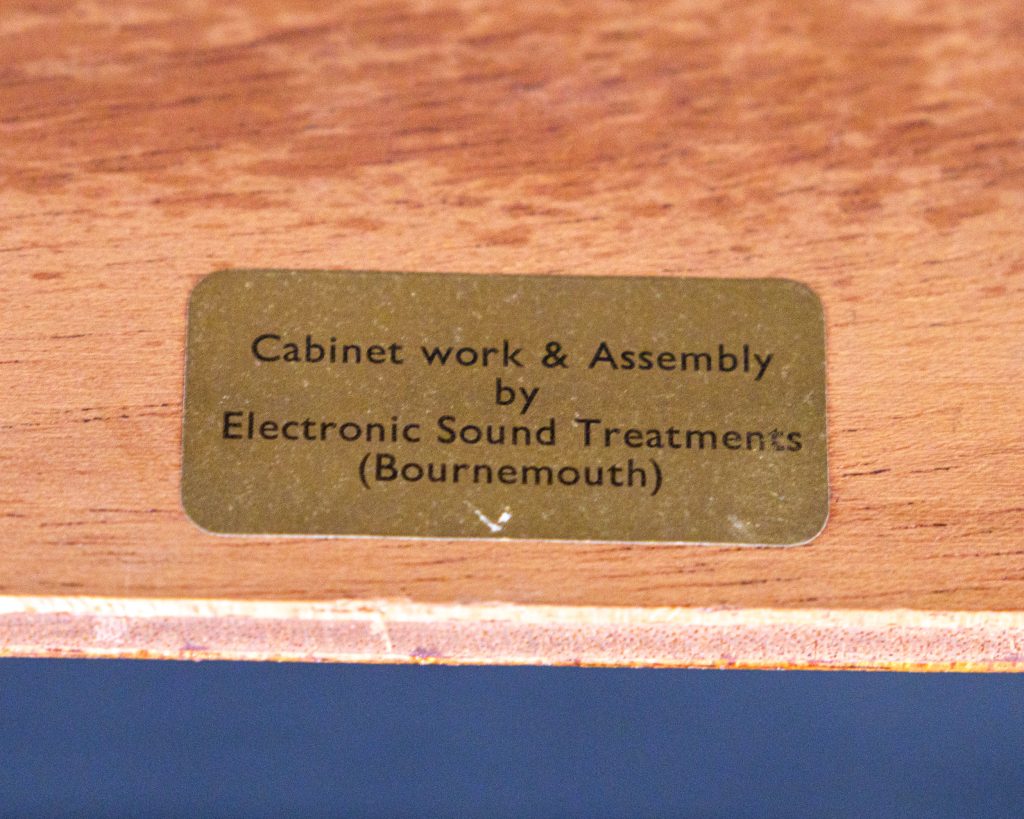
A metal badge on the wooden cabinet credits:
Cabinet work & assembly by Electronic Sound Treatments (Bournemouth)
which suggests a collaboration between Dewtron’s electronics and a local cabinet maker building finished instruments around the company’s modules.
Discovery via Reddit
In 2024, synth owner Andrew McGirr posted photos of an unidentified wooden‑cased monosynth to the r/synthesizers subreddit with a simple question: “Does anyone know what this is?”
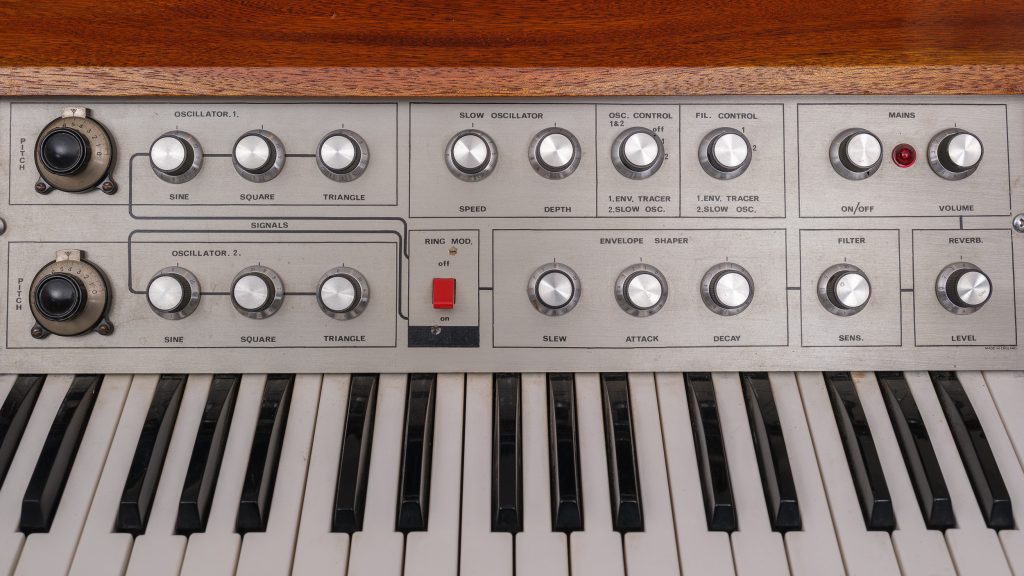
The panel, with its two oscillators, ring‑mod switch, Vernier dials and Gipsy script, looked familiar to a handful of vintage‑synth enthusiasts. The consensus quickly formed that this was a Dewtron Gipsy, one of the company’s rare complete instruments.
A follow‑up thread, “Dewtron Gipsy part 2,” documented Andrew’s efforts to find out more and decide what to do next. Community members suggested he contact Frequency Freaks, a Toronto‑based synthesizer workshop series, and its founder/organizer Paul Stillwell, for help assessing and documenting the instrument.
Frequency Freaks is a monthly gathering of synthesists, performers, and builders of all levels. Workshops feature live performances, demonstrations, technical deep‑dives, and lots of informal discussion. It turned out to be the perfect environment for turning a Reddit mystery into a preservation project.
The Rescue: Repair at Synths When
By the time Andrew brought the Gipsy to Toronto, it was in rough condition. The synth was not reliably producing sound, several controls were either intermittent or non‑functional, and decades of dust and oxidation were evident.
Andrew entrusted the instrument to Synths When, a local synth repair shop run by Jay Lemac. Jay and his team carefully brought the Gipsy back to life, enough that it could once again speak with its own voice.
The repair process also underlined why Dewtron instruments are so challenging to service:
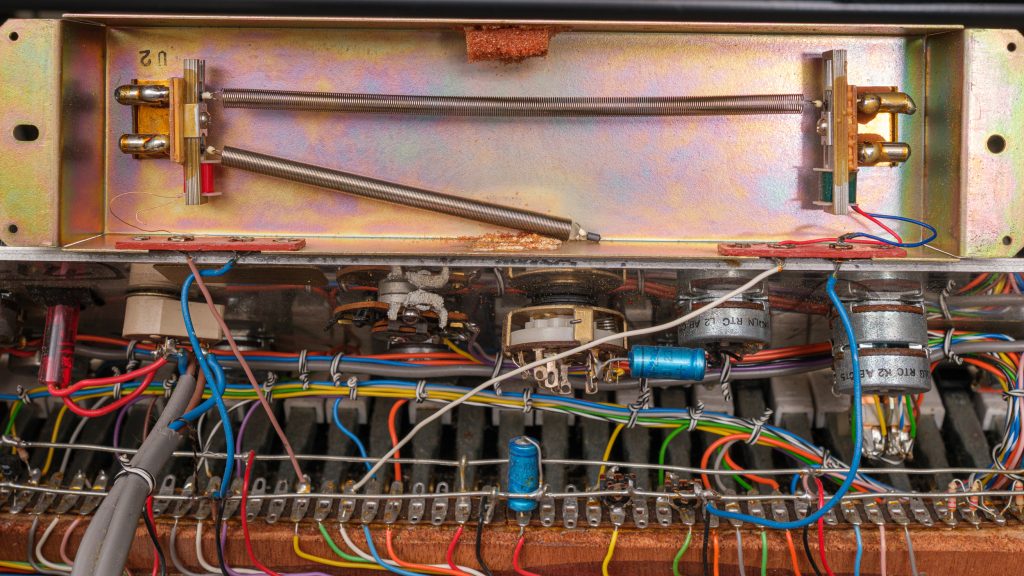
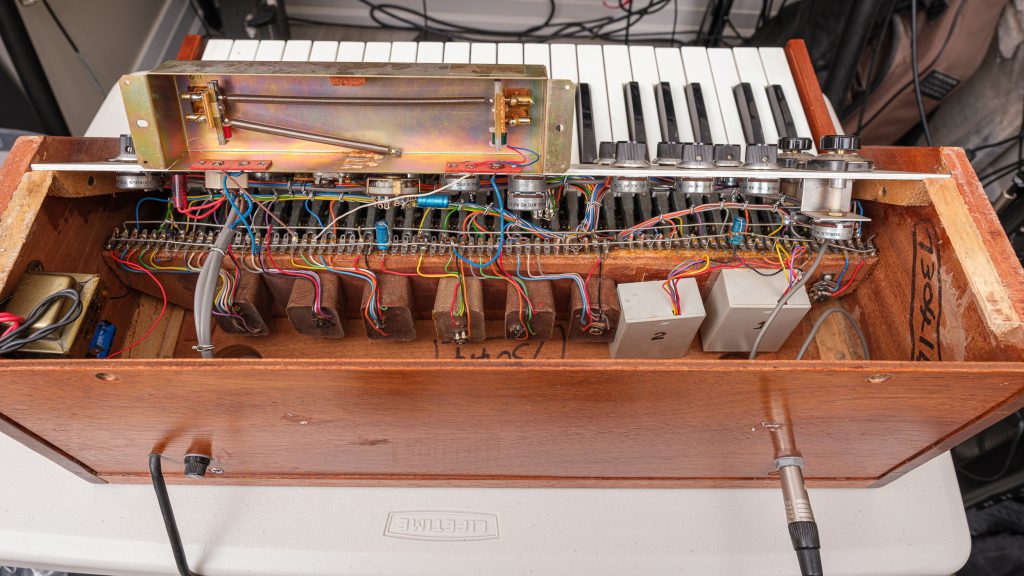
- Most of the critical boards – oscillators, filter, and other core modules – are completely potted in resin. This protects components and intellectual property but makes calibration and component‑level repair practically impossible.
- Wiring is done on old‑school tag strips. It is generally neat and logical, but time and environmental exposure take their toll.
- The spring reverb tank in this unit is missing one of its springs, limiting how accurately its original effect can be reconstructed.
Thanks to Synths When, the instrument is once again capable of generating sound, although “fully restored” would be too strong a claim. That limitation drove the decision to focus on preservation through sampling.
Features and Quirks of This Specific Gipsy
On the front panel, this Dewtron Gipsy offers:
- Two oscillators (Oscillator 1 and Oscillator 2), each with selectable sine, square, and triangle waveshapes.
- A shared Slow Oscillator (LFO) with Speed and Depth controls.
- An Oscillator Control section to route modulation.
- An Envelope Shaper with Slew, Attack, and Decay.
- A simple Filter section with “Sens.” control.
- A Ring Mod on/off switch.
- A Reverb section driven by an internal spring tank.
- Vernier dials providing fine pitch control for each oscillator.
- A three‑octave keyboard with traditional on/off keying and no velocity sensitivity.
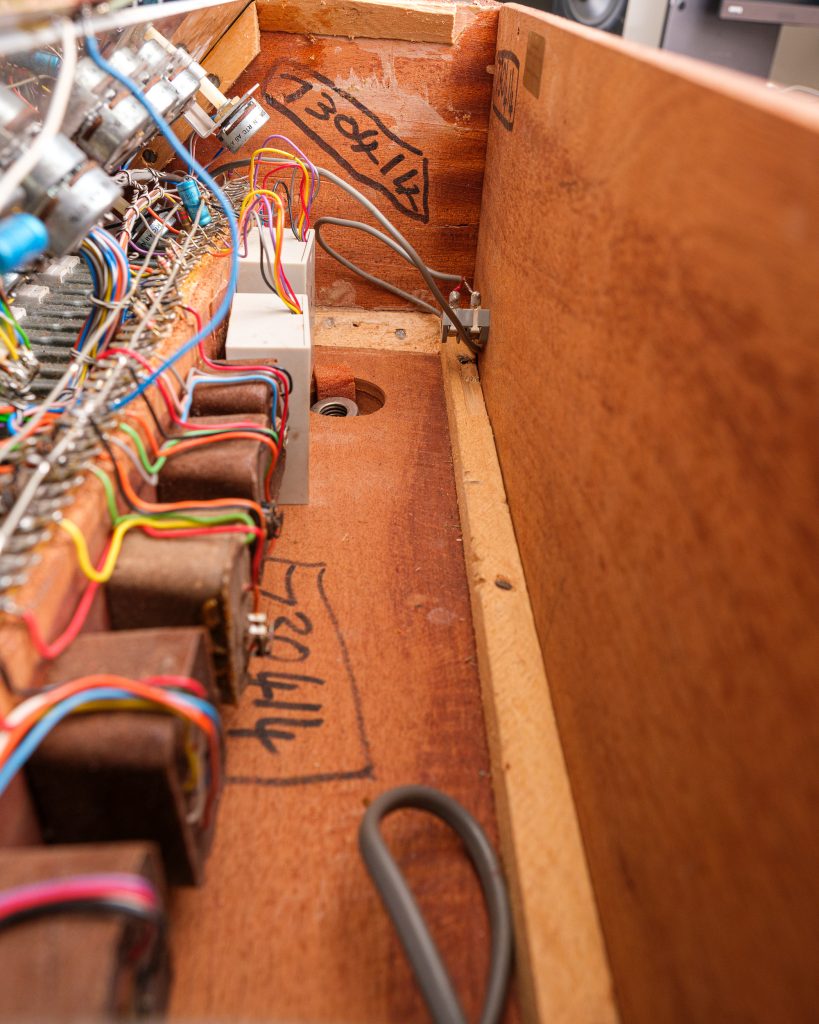
Internally, the instrument is assembled from Dewtron modules mounted behind the front panel and fully potted in resin. Tag‑strip wiring connects the modules to the keyboard contacts and rear panel jacks. Hand‑written markings such as “730414” appear inside the wooden case, but there is no formal model‑number plate beyond the Gipsy script on the front.
The unit’s behaviour is very much that of an ageing, partially serviceable Dewtron:
- The oscillators drift badly relative to each other and refuse to track together across the keyboard.
- The global tuning range is limited on the low side – this particular Gipsy cannot be tuned very low, which makes it impossible to say with confidence how the original low end would have sounded.
- The filter only “kind of” works, providing some tonal change but not behaving like a clean, well‑damped resonant filter.
- Many pots are scratchy, and mechanical wear is visible on keys and contacts.
- The spring reverb tank, missing one spring, behaves more like a quirky ambience generator than a classic smooth spring.
In other words: not a precision instrument, but a very characterful one.
Why Sample Instead of Attempting Full Restoration?
Given the potted modules and limited access to calibration points, there is only so much that any technician can do without risking irreversible damage. Further attempts to “fix” the Gipsy would likely involve destructive work on the resin‑encased modules, with no guarantee of success and a real risk of silencing the instrument permanently.
Under those constraints, sampling presents a pragmatic way forward:
- Capture the real sound of this specific Gipsy while it is still functional.
- Make that sound available to others who might never encounter a Dewtron instrument in person.
- Avoid the ethical and practical issues of destructive restoration on a rare piece of synth history.
The result is not a clinical, laboratory‑grade representation of what a brand‑new Gipsy might have done. Instead, it is a documented snapshot of this Gipsy, in its current, imperfect state.
The Sampling Sessions and File Structure
For the sampling work, the goal was to balance authenticity with usability. Because the oscillators cannot be tuned together and drift significantly over time, a per‑oscillator, per‑waveshape strategy was chosen rather than trying to capture “ideal” dual‑oscillator patches.
Each oscillator was recorded on its own, one waveshape at a time, using the synth’s own keyboard. Notes were recorded at positions across the keyboard as close to octave spacing as the tuning allowed. There is no velocity information – like most synths of its era, the Gipsy’s keyboard is strictly on/off.
To make the library practical in a wide range of workflows, samples were rendered at multiple sample rates and bit depths, and several “views” of the sound were captured:
- Raw oscillator tones (Osc1 and Osc2 separately)
- Oscillators through the ring modulator
- Oscillators through ring mod + filter
The folder layout reflects this:
Original Sample Files 96k 32b/
Complete, unedited original recordings at 96 kHz, 32‑bit float, grouped by oscillator and waveform. These are long takes from which the tuned single‑note samples were derived.Osc1 44.1k 16b/Osc1 48k 24b/Osc1 96k 24b/
Tuned, single‑note samples from oscillator 1 at three standard formats.Osc2 44.1k 16b/Osc2 48k 24b/Osc2 96k 24b/
Equivalent tuned sets for oscillator 2.Ring Mod 44.1k 16b/Ring Mod 48k 24b/Ring Mod 96k 24b/
Tuned samples recorded with the ring modulator engaged.Ring Mod Filter 44.1k 16b/Ring Mod Filter 48k 24b/Ring Mod Filter 96k 24b/
Tuned samples with both ring mod and filter active.
Within each of these folders, filenames indicate the oscillator (where applicable), waveshape, and target note (for example, Osc1_Square_C3.wav).
No additional processing has been applied other than gentle level management and pitch‑correction for the tuned sets. EQ, compression, and effects are left entirely to the user.
Raw vs Tuned Material
The library is built around two complementary ways of working with the Gipsy:
1. Original Sample Files 96k 32b
- Long, continuous recordings organized by oscillator and waveform.
- Ideal for anyone who wants to:
- Analyze tuning drift and scaling over time.
- Cut custom sample sets according to their own criteria.
- Study noise, hum, and artefacts of this specific instrument.
2. Tuned folders (Osc1/Osc2/Ring Mod/Ring Mod Filter …)
- Individual samples tuned as closely as possible to the nearest Western pitch.
- Designed for quickly building playable instruments in SFZ, Kontakt, DecentSampler, Ableton Sampler/Simpler, and similar tools.
- Because oscillator 1 and 2 are separate, users can recreate the “almost in tune, always drifting” character in a controlled way by layering and detuning samples inside their sampler.
This dual approach respects the historical instrument while also acknowledging that most musicians need reasonably in‑tune material to actually write music.
Using the Gipsy in Your Own Music
There is no single “correct” way to use these samples, but a few ideas may help people get started:
- Build a basic monophonic instrument from the Osc1 or Osc2 tuned folders and use it as a raw‑tone source for modern effects chains.
- Layer Osc1 and Osc2 versions of the same note, detuned slightly in your sampler, to mimic the unruly dual‑oscillator behaviour of the hardware – but with the option to tame or exaggerate it.
- Use the Ring Mod and Ring Mod Filter samples when harsher or more percussive sounds are needed. They work especially well for drones and experimental textures.
- For sound‑design and education, compare tuned samples against segments of the Original Sample Files to hear how much the instrument wanders over time.
If you create SFZ/Kontakt/DecentSampler definitions, Ableton racks, or other instrument presets based on this library, contributing them back to the project will help other musicians make more of this almost‑forgotten synth.
We hope you enjoy and have fun with the Dewtron Gipsy Samples!
Credits
This project is the result of a small but enthusiastic chain of events and people:
Andrew McGirr – Owner of this Dewtron Gipsy. Andrew found the synth, shared it with the world via Reddit, and chose to preserve it rather than let it gather more dust.
Paul Stillwell – Founder and organizer of Frequency Freaks, a monthly synthesizer workshop series in Toronto. Paul performed the recording sessions, editing, tuning, and organization of the sample library, and prepared the documentation and photos.
Jay Lemac and the team at Synths When – Synths When brought the Gipsy back to the point where it could reliably make sound again, making the sampling sessions possible.
If you use these samples in a project or create derived instruments, please include a credit line such as:
“Dewtron Gipsy samples by Paul Stillwell and Andrew McGirr.”
License
The sample library and accompanying documentation are released under the Creative Commons Attribution 4.0 International (CC BY 4.0) license.
You are free to:
- Share — copy and redistribute the material in any medium or format.
- Adapt — remix, transform, and build upon the material for any purpose, even commercially.
Under the following terms:
- Attribution — You must give appropriate credit, provide a link to the license, and indicate if changes were made. You may do so in any reasonable manner, but not in any way that suggests the licensors endorse you or your use.
Recommended attribution:
“Dewtron Gipsy samples by Paul Stillwell and Andrew McGirr.”
Full license text: https://creativecommons.org/licenses/by/4.0/
Further Reading and References
For anyone who wants to dig deeper into Dewtron history and the wider context of this instrument, the following links provide a solid starting point.
Community discussions and identification
- Reddit – original identification thread: https://www.reddit.com/r/synthesizers/comments/1kung51/does_anyone_know_what_this_is/
- Reddit – follow‑up and restoration thread (“Dewtron Gipsy part 2”): https://www.reddit.com/r/synthesizers/comments/1ovoshp/dewtron_gipsy_part_2/
- ModWiggler – Dewtron / Gipsy discussion and background on Brian Baily and the company: https://www.modwiggler.com/forum/viewtopic.php?t=158553
Online overviews and sightings
- Electronic Music Wiki – Dewtron overview: https://electronicmusic.fandom.com/wiki/Dewtron
- Sequencer.de – “Exotic synthesizers: Dewtron synthesiser Apollo A1 + Gipsy”: https://www.sequencer.de/blog/exotic-synthesizers-dewtron-synthesiser/765
- MATRIXSYNTH – Dewtron tag (assorted posts on Dewtron gear): https://www.matrixsynth.com/search/label/Dewtron
Magazine archives and adverts
- Music Technology – “The A–Z of Analogue” (November 1993, includes Dewtron entry): http://www.muzines.co.uk/articles/the-a-z-of-analogue/7644
- Practical Electronics – October 1971 (Dewtron products and advertising): https://www.worldradiohistory.com/UK/Practical-Electronics/70s/Practical-Electronics-1971-10.pdf
- Studio Sound – March 1973 (Dewtron adverts / coverage): https://www.scribd.com/document/517250738/Studio-Sound-1973-03
- Studio Sound – June 1973 (additional Dewtron adverts / coverage): https://www.worldradiohistory.com/UK/Studio-Sound/70s/Studio-Sound-1973-06.pdf
- Beat Instrumental – September 1973 (Dewtron advertising): https://www.worldradiohistory.com/UK/Beat-Instrumental/Beat-Instrumental-1973-09-S-OCR.pdf
- Music Technology – November 1993 (issue including a Dewtron Gipsy mention): https://www.worldradiohistory.com/UK/Music-Technology/Music-Technology-1993-11-S-OCR.pdf
Related sites
Frequency Freaks – Toronto’s monthly synthesizer workshops: https://www.freqfreaks.com
Intrepita – Paul Stillwell’s personal site (music, photography, and articles): https://intrepita.com
The hope is that this combination of photos, history, and an open sample library keeps at least one Dewtron Gipsy from fading into complete obscurity – and maybe inspires a few new pieces of music along the way.
Many thanks for reading!
Paul Stillwell and Andrew McGirr